

Patagotitan mayorum: The Colossus That Rewrote Dinosaur History
A few years ago, researchers from the Feruglio Museum (MEF) in Trelew unearthed the remains of a creature that pushes the very boundaries of imagination: Patagotitan mayorum, the largest dinosaur ever recorded on Earth.
With an original femur measuring nearly 7.9 feet in length—a single bone that surpasses half a ton in weight—this behemoth dethroned previously known titans like Neuquén’s Argentinosaurus, yet cementing Patagonia’s status as the undisputed realm of Cretaceous giants.
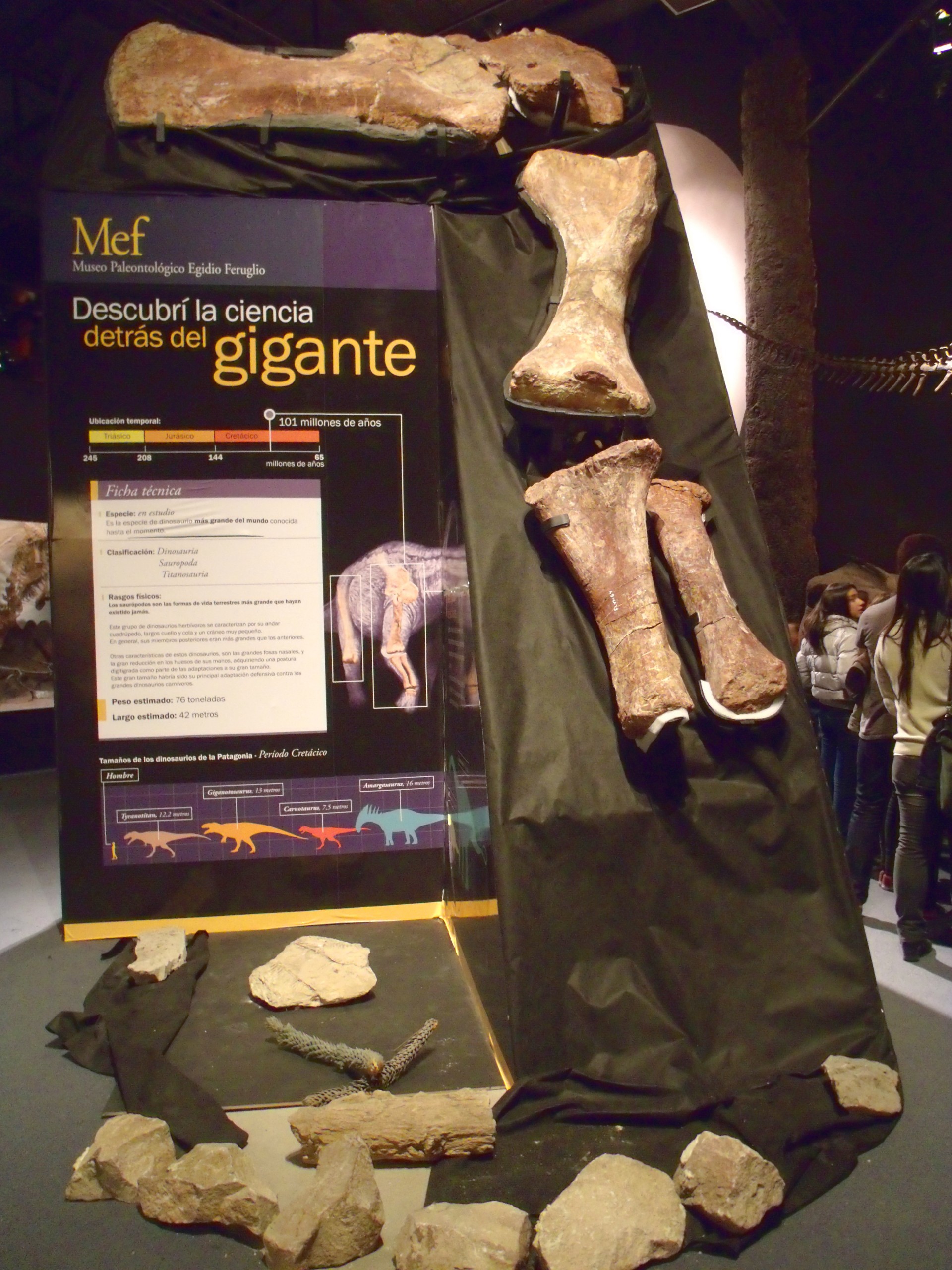
The epic tale of its discovery was, as is often the case with monumental scientific breakthroughs, an exquisite stroke of serendipity. The saga began in 2012 when Aurelio Hernández, a ranch hand traversing the vast 31,630-acre expanse of the La Flecha estate (now owned by the Mayo family) in the remote outpost of El Sombrero, spotted a colossal bone protruding from the arid steppe. He immediately sounded the alarm, and astonishment soon swept over paleontological technician Pablo Puerta and the Feruglio Museum team. The initial field expeditions, launched in January 2013, confirmed that this sweeping landscape was harboring a treasure trove of incalculable value.
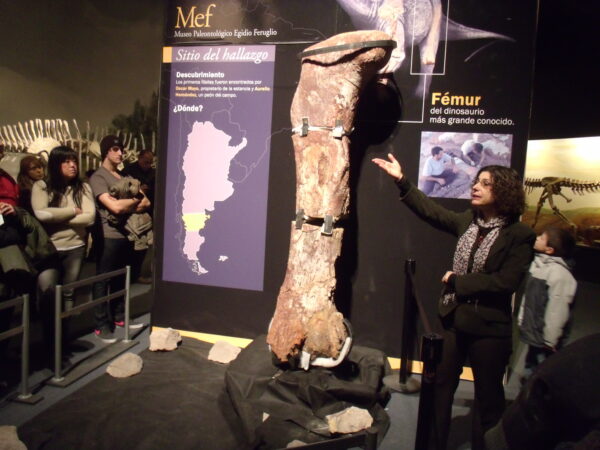
The sheer logistics of the excavation were monumentally complex, eventually revealing a dazzling prehistoric necropolis. “When we began to dig and uncovered the femur alongside other bones like the pelvis, ribs, and humerus, we were left utterly speechless,” recalls José Luis Carballido, a biologist and researcher with CONICET.
This rocky tomb did not hold just a solitary individual; it yielded an extraordinary 240 fossilized remains belonging to seven distinct specimens, all frozen in time beneath what was once a lush, sweltering jungle.
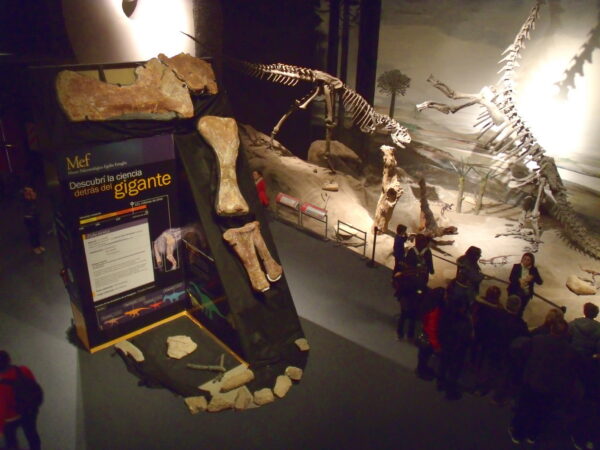
This fabulous specimen belongs to the sauropod family—those towering, long-necked herbivores that roamed in herds in perpetual search of grazing grounds. They are, without a doubt, the most majestic terrestrial creatures to have ever walked our planet.
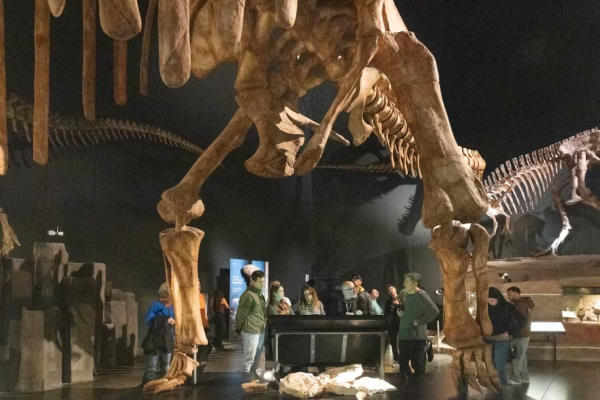
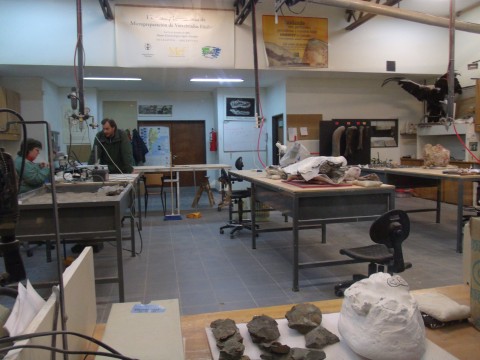
To safeguard this paleontological crown jewel and conduct exhaustive studies, the bones were encased in heavy-duty burlap and plaster jackets for their painstaking journey to the Egidio Feruglio Museum (MEF). The overwhelming volume of salvaged pieces allowed scientists to reconstruct up to 70% of the skeleton, offering unprecedented certainties to the scientific community. Such a monumental find not only spurred the creation of a fascinating “replica factory” using 3D modeling to fill in the missing gaps, but it also compelled the museum itself to undertake a massive expansion of its facilities, culminating in a triumphant grand reopening in November 2024.
Founded in 1990, the MEF has occupied its current headquarters since 2000, though it had to literally stretch its walls to house the Patagotitan, which had temporarily been exhibited at the Trelew Convention Center in 2015. The ambitious expansion took five years, during two of which the museum kept its doors closed to the public.
Highly educational and infinitely engaging, the MEF navigates the three great periods of the Mesozoic era: the Triassic, Jurassic, and Cretaceous. Wandering its halls is a constant catalyst for curiosity—a voyage into a deep, remote past that helps us understand the evolution of life on Earth. The institution honors the Italian geologist Egidio Feruglio, who arrived in Patagonia in 1920 following the discovery of oil in Comodoro Rivadavia. His exhaustive fieldwork ultimately established him as a foundational figure in Patagonian geology and paleontology.
For Rubén Cúneo, the director of the MEF, the arrival of the Patagotitan marks the absolute zenith of modern paleontology—an evolutionary “arms race” where Patagonia simply boasts “the biggest and the ultimate of everything.”
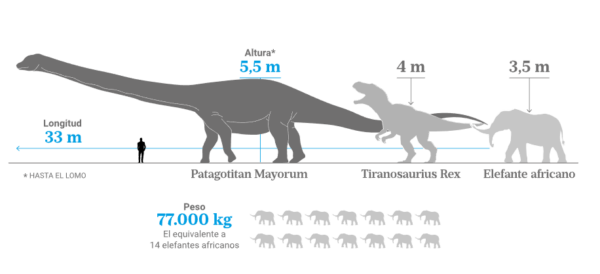
Thanks to the remarkable fidelity of the restored skeleton, experts were able to calculate its mass with pinpoint precision: the Patagotitan tipped the scales at a staggering 77 US tons, an awe-inspiring weight equivalent to more than a dozen adult elephants.
Possessing a stature that borders on the surreal, this imposing creature stretched approximately 108 feet from snout to the tip of its tail, standing a majestic 21.3 feet tall in its resting posture.
Having captivated global audiences in venues as prestigious as the American Museum of Natural History in New York, Madrid’s CaixaForum, and exhibition halls from London to Singapore through its flawless reproductions, these bones continue to unveil precise, intimate anatomical secrets of the dinosaur age.