Aconcagua Provincial Park is 185 km away from the city of Mendoza, near the border with Chile. Here is located the highest mountain in the entire American continent, the Aconcagua, with 6,962 mts high., an icon of world mountain climbing. Trekking tourists, mountain climbers and ecotourists in general tour it during the whole year.
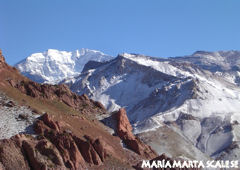
The entrance to Aconcagua Provincial Park is 2 km away from Puente del Inca.
The origin of the name ‘Aconcagua’ is the term in quechua language “Ackon-Cauak”, which means ‘Stone Sentinel’.
Area attractions
Trekking is one of the most developed activities within the park.
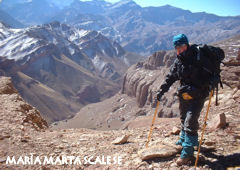 There are several paths for trekking inside the park but most of the fixtures and the places to visit in the tours are for mountain climbers.
While planning or starting any tour, it is important to take into account the altitude as the main obstacle of the area. A quick ascent may bring about ‘mountain sickness’ (nauseas, headache that does not disappear with aspirins, insomnia, loss of appetite, breathing difficulties, vertigo, etc.)
From the entrance to Confluencia
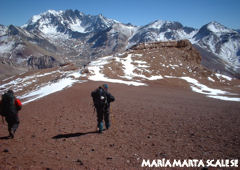 The first trail is the same for trekkers and climbers. It goes through the beautiful Laguna de Horcones (a lagoon) and the Quebrada del Durazno (a ravine). After going through Valle Horcones, a valley of short vegetation and lots of greenery, you will approach Confluencia. This path implies medium difficulty and it is well marked.Further ahead, the landscape slowly turns white and the path that borders the river will lead you to the place where the rivers originate while approaching the Inferior Horcones Glacier. The trekking lasts from 4 to 6 hours.
Trekking to Plaza Francia
From Confluencia you can reach Plaza Francia. This camping site constitutes the base for the mountain climbers who try to climb the southern face of the Aconcagua, the most difficult one. One of its main characteristics is the few vegetation and the soft winds, which gives camping a good chance. From Plaza Francia you will ascend to the Almacenes (4,800m) and Mirador (5,800m) hills.
Trekking to Plaza de Mulas
Plaza de Mulas is at 4250 m.a.s.l.. You can visit the high camping sites and the surrounding hills, always returning for bedtime. To get there from Confluencia you will go through a humid which from Piedra Grande on, it continues to the right of the Horcones River. You will later access Playa Ancha and later, Quebrada del Sargento (a ravine). Towards the end, heading to Cuesta Brava, you will get to Plaza de Mulas.
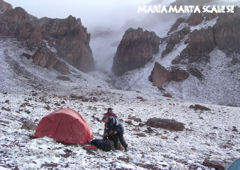 During the tours you will be able to see the autochthonous flora and fauna that presents special adaptations to the extreme dry conditions, to wind and cold. The limit to vegetation is at 4000m approximately where the ‘Altitude desert’ begins.
The condor lives at great heights. It constitutes a very important piece for the ecosystem since it is a carrion-eater bird that helps to avoid pollution and diseases. Other animals at these great heights are small rodents and small lizards.
Park’s general info
A right ascent takes time so as to give the body the chance of adapting to the weather and to the altitude. The first compulsory part if from Horcones until Confluencia, and only a few days later you can continue with the rest of the parts.
 The park does not count with visitors’ area, that is to say, no public restrooms, restaurants, groceries stores, accommodation or regular transportation. The nearest service center is Puente del Inca, which is 4kms away.
For drivers it is advisable to always have the gas tank full, radiator water with anti freezing /cooling products and to take all the security elements: lights in good conditions, 5 liters of water for the radiator, cellular.
There are no compressed natural gas stations.
Access to the park
You have to get an access permission which you can get in person at the Customer Services stand in order to enter the National Park. People under age 14 can only access until Quebrada de Durazno, which is 3,100m.
On the rest of the park, minors of ages between 14 and 21 can only enter with a certified authorization of both parents.