Did you know that the whales don’t form couples but mating groups? Why are the whales the species with the biggest testicles in the animal kingdom? Why can it be said that whales are giant water filtering machines? What are the formations similar to callosities the whales have on the upper part of their bodies?
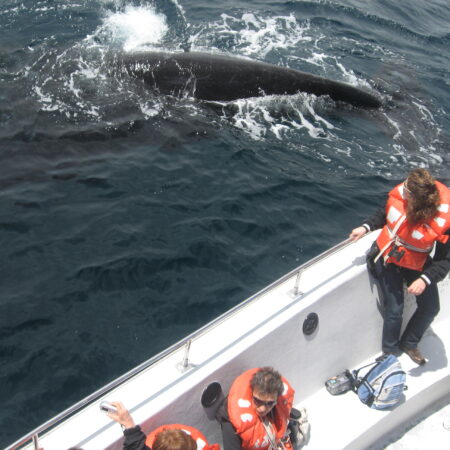
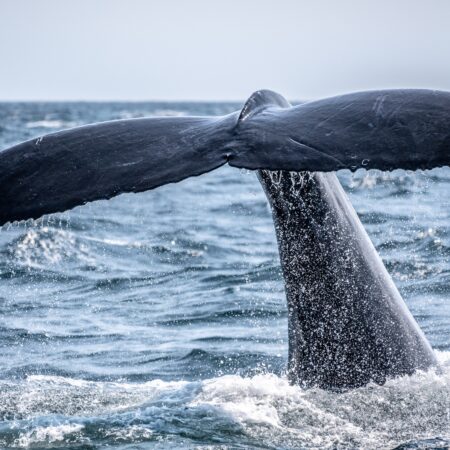
Know a series of curious data on these mammals, giants of the sea that every year arrive in June to the coast of the Peninsula of Valdés to stay until the very end of spring. There they will mate and you will be able to see how the calves, born in previous years and perfectly identified by the investigators for the study of the population, are getting on.
The whales and their “Families”
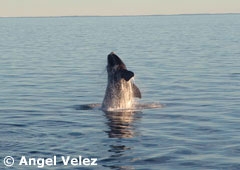 Contrary to what is believed if one bears in mind the interwoven unity of the mother and their offspring, the whales don’t form steady family groups. Their system of mating is promiscuous, they form sexual groups that can be observed very well in the Valdés Peninsula, in which there is a female and several males. The males compete among them to fecundate the female.
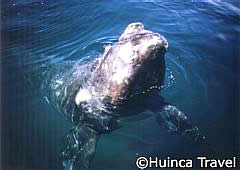 This competition is the reason for the peculiar characteristic of this species: the size of the testicles of the male individuals. They are the biggest in relation to their corporal weight in the whole Animal Kingdom. It happens that, since several males compete in a sexual intercourse group, the one with more chances of fertilizing the only ovum of the female will be the male that produces a bigger quantity of sperm. It is a peculiar case of intrasexual competition called “spermatic competition.”
To filter to eat
The Right Whales have an immense mouth, caused by an extremely arched superior jaw, inside which there are some extremely long beards. These beards are bigger than a tall person: an adult could fit, standing with his/her arms spread out, inside the mouth of a whale.
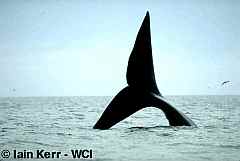 The whales swallow tons of sea water, then close their mouth and draw all the water from the mouth, filtering it with the beards. Large quantities of food, such as plankton and other microorganisms, remain trapped in the “beard”, and are withdrawn by their huge tongue.
In the waters of the Peninsula Valdés one can watch for hours on end how the whales swim and feed continuously, absorbing tons of water.
Callosities on the back?
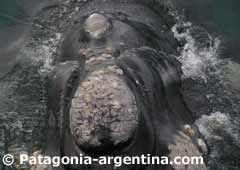 One way of recognizing a Right Whale is by noting the presence of certain characteristic callosities on the upper part of its body and at the sides of the head.
These callosities are covered by thousands of crustaceans known as “Whale lice”, or more properly called crustaceans.
These crustaceans are born, grow, reproduce and die on the body of the whales. They are crustacean parasites. They are located on every part of the body where they are protected from the currents.
Bibliographical source: Institute of Conservation of Whales
(Instituto de Conservación de Ballenas)
Translated into English by Geoffrey Astbury.