


Sarmiento: The Secret of the Petrified Forest
Nestled between the basins of lakes Colhué Huapi and Musters, this small town rests in the lush valley fed by the Senguer River. A realm where lakeside serenity invites quiet navigation and the pursuit of wild trout.
Born in the Andean snows of Lake Fontana, the Senguer River feeds Lake Musters before meandering toward Colhué Huapi, forming a hydrological lifeline that transformed the windswept steppe into a fertile agricultural oasis. Today, this vital artery sustains Sarmiento and supplies distant Comodoro Rivadavia.
The shores of Lake Musters harbor understated retreats for travelers seeking to venture onto its waters or cast a line for salmonids amidst the arid expanse.
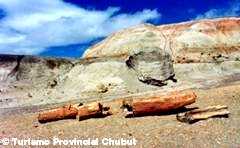 Yet the region’s true geological masterpiece lies just a few miles away: the José Ormachea Petrified Forest.
Sixty-five million years ago, this barren landscape was a warm, humid jungle dominated by towering conifers and Mesozoic fauna.
Today, across badlands that mimic a lunar topography, colossal trunks of mineralized stone emerge from the multicolored folds of the hills.
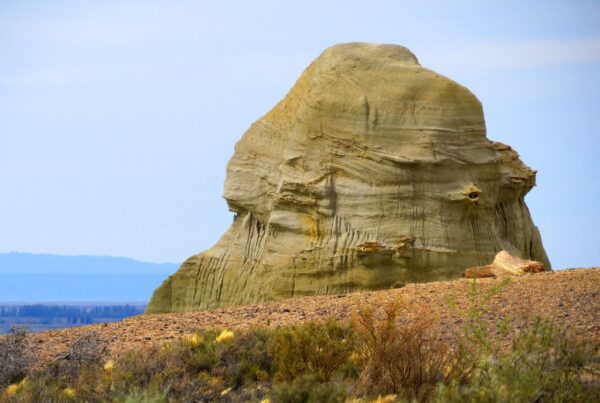
Stepping into the protected reserve, the sheer scale is overwhelming: scattered across a vast landscape lie monumental trunks, pristine stumps, and fossilized impressions of leaves and seeds. Paleobotanical evidence confirms that this primordial canopy shielded trees that once soared past 330 feet in height.
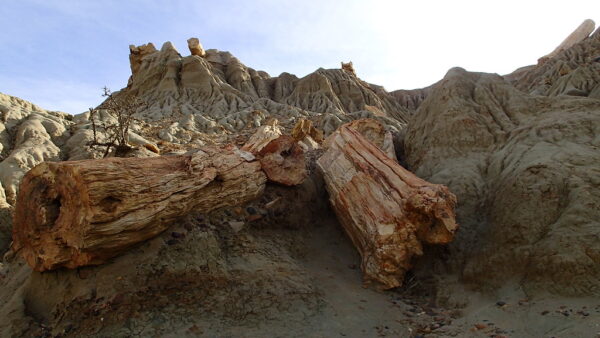
The surrounding canyons reveal the layers of this metamorphosis: nestled among iron-rich sediments known as Piedras Coloradas lie marine bivalves and dinosaur fossils, silent witnesses to ancient oceanic transgressions.
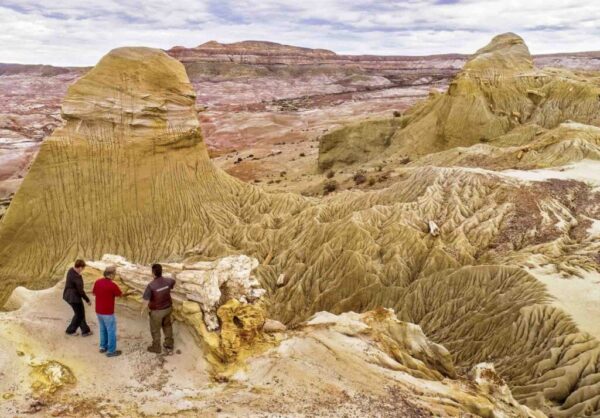
The creation of this monument in silica required an alignment of rare geological events. In primordial Patagonia, the birth of the Andes Mountains blocked humid Pacific winds, triggering torrential falls of volcanic ash rich in silicon dioxide over the forested basins. That pyroclastic blanket smothered decay, creating a sealed environment ripe for mineral infiltration.
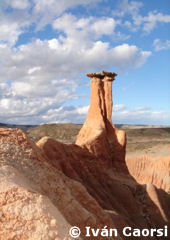 Over millennia, silica-saturated waters seeped into the plant tissue, replacing organic matter molecule by molecule with quartz and jasper, leaving the wood’s delicate microstructure perfectly intact.
Entombed beneath layers of sediment, the ancient forests of the Cenozoic Era remained hidden until the relentless winds of the steppe swept away the topsoil.
Today, eolian erosion lays bare this stone sanctuary: irrefutable proof of an era when the arid heart of Chubut was one of the lushest realms on Earth.