

The road to Argentina’s Los Glaciares National Park offers awe-inspiring sequences of views.
You leave downtown El Calafate, wind past the milky-turquoise waters of Lago Argentino, and watch the jagged peaks of the Andes slowly rise to meet you, all before coming face-to-face with the immense, electric-blue wall of the Perito Moreno Glacier.
But travelers making the trek recently have run into an entirely unexpected sight on the gravel plains of Estancia Alice: a fleet of modern combine harvesters kicking up dust clouds against a backdrop of snow-capped peaks.
Against all odds, southern Patagonia has just completed its first successful, large-scale harvest of wheat and oats.
A Radical Shift in the Patagonian Landscape
Historically, this corner of the world has been defined by its beautiful hostility. It’s a land of fierce Andean winds, pristine ice fields, and vast sheep estancias (ranches) where little more than hardy tussock grass manages to survive. The idea of growing commercial crops here was long dismissed as an agronomic impossibility.
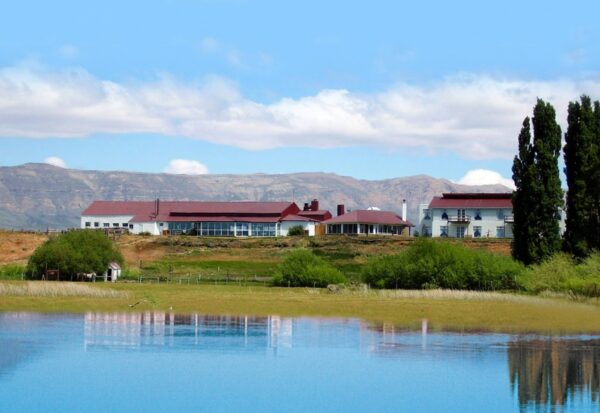
Enter AgroCalafate, a pioneering venture founded by local agronomist Tomás Ciurlanti alongside partners Nicolás Zuber and Ricardo Coggiola. Over the 2025/2026 season, the trio turned a 740-acre plot at Estancia Alice—lying right at the foot of Cerro Frías—into a living experiment.
The strategy required absolute synchronization with the extreme southern elements:
- The Prep: Fields are tilled in the crisp autumn.
- The Soak: Throughout the brutal winter, the dormant soil is deeply recharged by pure glacial meltwater.
- The Growth: Seeds are planted in the spring, rushing to mature during the fleeting summer months when Patagonian days stretch out with up to 17 hours of intense daylight.
Despite unseasonably heavy rains during March and April that threatened to damp the fields, the gamble paid off spectacularly. Some of the long-managed plots yielded up to 3,120 pounds per acre for oats and 2,670 pounds per acre for wheat—competitive numbers that have stunned traditional agriculturalists.
From Glacial Dust to a Sustainable Future
For the luxury traveler or culinary explorer visiting El Calafate, this isn’t just an interesting piece of farming trivia; it marks the beginning of an ecological and gastronomic evolution for the region.
The grains harvested are currently destined for a regional processing facility in Río Gallegos to create balanced feed, a massive win for local food security. Historically, keeping livestock fed through the unforgiving Patagonian winter required shipping expensive feed thousands of miles from the fertile northern pampas. By producing grain locally, the region is taking its first major steps toward building a self-sustaining agricultural ecosystem.
Further, the leftover crop stubble provides vital winter fiber for local herds, encouraging smarter, technical crop rotations that will gradually enrich Patagonia’s delicate topsoil.
For those who love this wild frontier for its untouched, dramatic solitude, the visual of a tractor working a golden field of wheat just 25 miles from one of the world’s most famous glaciers is a striking reminder that the “utter end of the world” is a place alive with reinvention.
Neighbors are already taking note, and more estancias are planning to break ground next spring. The next time you order a fresh artisanal loaf or a locally distilled spirit in El Calafate, you might just be tasting a piece of history grown right on the glacier’s edge.