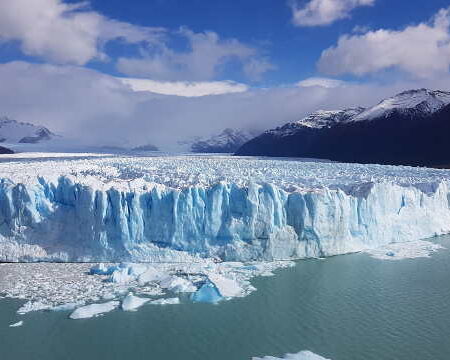


At 35 ºF, the water steals your breath before you even break the surface.
Facing the imposing wall of the Perito Moreno Glacier, right in the heart of Los Glaciares National Park, the profound silence of winter in Patagonia is barely interrupted by the occasional crack of ancient ice. In this majestic setting, diving into Lake Argentino is no longer an eccentricity—it has evolved into a high-precision discipline.
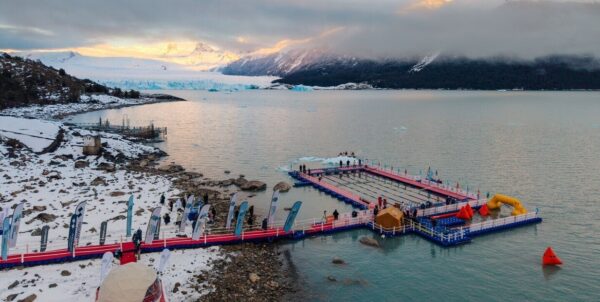
Without wetsuits, armed with nothing more than a traditional swimsuit and goggles, swimmers from fifteen different countries—ranging from the freezing Nordic nations to Brazil and Chile—converge on an unprecedented structure for the region: a floating semi-olympic pool measuring 30 by 30 meters, anchored directly in the spectacular Bahía de los Témpanos (Iceberg Bay). This marks the very first time that winter swimming, a sport with deep European roots, has brought its circuit to this latitude of the continent. The 2026 World Cup was held right here.
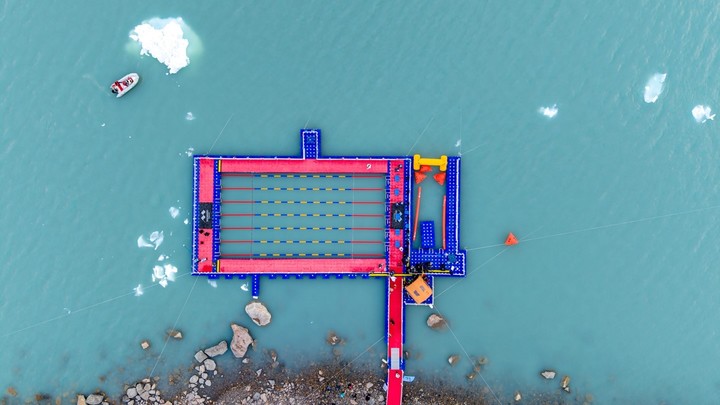
Naturally, the logistics behind this massive immersion strictly respect the scale and purity of the environment. The floating platform features environmental certifications that bring the circulation of motorboats around the swimmers down to zero, guaranteeing a minimal impact on the local ecosystem. The result is a raw, purely analog swimming experience, where athletes find themselves completely isolated before the immense block of blue ice.
Those who dare to jump into these lanes face a challenge that is as physical as it is deeply mental. Whether in the fast-paced 25-meter butterfly sprints or the exhausting 450-meter open water courses, the thermal shock demands absolute breathing control. There is no room for hesitation at the edge of the pool; all that remains is the direct, striking contrast between the human body and the extreme temperature.
The experience, although solitary once in the water, is shared by a vibrant community watching from the shore. Hundreds of spectators gather at the bay to cheer on swimmers ranging from absolute beginners in icy waters to seasoned athletes with years of experience in Northern European championships.
For all of them, the real training happens before the jump: a rigorous psychological preparation that allows them to master their primal instincts the moment they make contact with the cold.