

It is no secret that Patagonia shelters fantastic stories, extraordinary men, and almost impossible missions. Julio Popper and the search for gold is one of them.
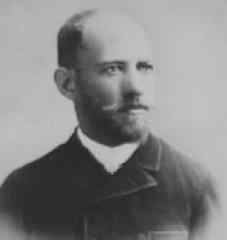 Julio Popper was a young Romanian, born into a Jewish family in Bucharest in 1857. As if to add to the legend, the exact date of his birth is unknown. His family came from Poland. His father, Naftalí, was a prominent intellectual who mastered several languages and, among other achievements, founded the first Israelite school in Bucharest, with an advanced educational program for its time. To the scandal of the Orthodox community, classes were taught not in Hebrew but in Yiddish, Romanian, and German. Journalism was another of his pursuits: he edited a liberal Romanian-Yiddish bilingual weekly called “El Tiempo”, which survived only three months because it was rejected by the more conservative sector of the Jewish community.
As we can see, life was not easy for a young man with aspirations within a minority community such as the Jews of Bucharest in the mid-19th century.
Popper wanted to enroll at the Polytechnic University of Bucharest, but he was denied admission because of his Jewish status. Eventually, he chose to emigrate in search of better opportunities. He studied at the Polytechnic University of Paris and at the National School of Bridges and Roads, where he graduated as a Mining Engineer. During this period he taught classes to finance additional studies at La Sorbonne in physics, chemistry, meteorology, geology, geography, and ethnography. He was fluent in German, Romanian, Yiddish, and French, and also had knowledge of Italian, Latin, and Greek.
It is curious how the word “Patagonia” first came to his attention. He recalled in his writings that, while passing a circus during one of his trips to Europe, the showman invited passers-by to enter by announcing that they could see “an Indian of the tribes of Australia, of the cannibals of Patagonia, which had eaten raw the tongue of his mother-in-law.”
Travel starts
Seeking new opportunities, he first traveled to Constantinople, then to Egypt, where he worked on maintenance tasks related to the Suez Canal. From there he journeyed through the Middle East, India, China, and Japan. In 1881 he returned to Romania, but only briefly to visit his family. He did not know it would be the last time he would ever see them…
He tried to establish relationships with the members of his country’s Geographic Society, but his personality was clearly made for travel, and that same year he embarked on a new journey that would take him to Siberia, then Alaska, Canada, and finally the United States. There he spent considerable time in New Orleans, where he participated in the planning of the city’s canal system and urban development.
The following year he traveled to Cuba, then still a Spanish colony. There he prepared an urban development plan for Havana and its port. He then went to Mexico, where he began his career as a journalist for the “Diario de Los Forasteros”, the newspaper of the foreign communities. After carrying out several cartographic projects, he traveled to Brazil. While there, he learned that gold had been discovered in the Strait of Magellan. Without hesitation, he immediately departed for Buenos Aires. He was 28 years old.
The brightness of gold
The fantasy of El Dorado still held a powerful place in the imagination of the time, and even more so for Popper, who saw in it not only the appeal of legend but also the prospect of a very real and profitable enterprise.
Buenos Aires’ newspapers compared this unexplored region to the American West, California, and the Yukon. After all, in both cases these lands represented “the end of the world”: the unknown, the territory beyond the explored frontier, and the land of myths and legends.
Popper’s first reconnaissance expedition took place between March and May of 1886. It covered the route from Cabo Vírgenes to Punta Arenas. In October of that same year, he first set foot on Tierra del Fuego. What he found on these journeys was far from the “El Dorado” or the “City of the Caesars.” Only on the beaches of Punta Arenas did he discover small quantities of gold-bearing sands.
However, upon returning to Buenos Aires in 1887, he delivered such an enthusiastic lecture that it led to the founding of the Washed Gold Southern Company. Its members belonged to the elite of the time: José María Ramos Mejía, Joaquín M. Cullen, Alfonso Ayerza, Tomás A. Le Breton, Emilio Lamarca, and other prominent figures from the commercial world.
As Director of this mining company, in the spring of 1887 Julio Popper returned to Tierra del Fuego.
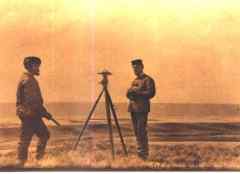 At that time, one of the government’s main concerns was to establish permanent settlements in this remote region of the country. The Treaty of Limits with Chile had been signed only a short time earlier, and the “gold rush” unleashed by the first discoveries only created additional difficulties. The “beaches with golden sands” lay on the opposite side of the island, separated from Ushuaia by mountains and located in an area that was extremely difficult to control.
Popper was first and foremost an explorer. He enjoyed venturing into inhospitable places, naming the landmarks he discovered and experiencing the unique thrill known only to pioneers. But he wanted something more, and the discovery of rich gold-bearing sands on the beaches of the northern shore of San Sebastián Bay gave him the opportunity he had been seeking: to become a pioneer in extracting gold through a productive mining enterprise.
He settled in the middle of a desolate landscape, swept by relentless winds, which he named “El Páramo” (The Moor). He first traveled to Punta Arenas to recruit workers, but few paid attention to him. The excitement surrounding the first gold discoveries at Cape Virgins had already faded, and no one believed he could make a fortune from the venture. But when the gold extracted by Popper began circulating among the small population of the Strait of Magellan, interested parties quickly appeared. And not all of them had good intentions.
One of Popper’s men recalled that, at dawn one day, they spotted several tents in the distance. They belonged to deserted sailors, escaped convicts, and people of every background who had come from Punta Arenas “to see what was going on.”
This marked the beginning of a series of increasingly serious incidents. In one of them, Popper retaliated harshly against looters who had taken advantage of one of his trips to Buenos Aires to steal 24 kilograms of gold. According to his own account, the Romanian “managed to restore order within the establishment.” Apparently, he even went so far as to imprison the offenders, despite having no legal authority to do so, before sending them back to Punta Arenas in rather poor condition (most of the usurpers were Chilean). This provoked a formal complaint from the Chilean government. The episode illustrates Popper’s personality well: he considered himself the authority in his territory, imposed his own rules and regulations, and took it upon himself to punish those who violated them.
Retaliation was swift. Popper’s enemies were numerous: Chilean gold prospectors who viewed him as a competitor, the governor of Tierra del Fuego, who saw his authority weakened over a large portion of territory where Popper effectively ruled, and Chilean officials in Punta Arenas, who even signed a petition against “the vandal of modern barbarism.” The conflicts that followed ended with nearly all of Popper’s establishments being reduced to ashes.
The end of the company
The Washed Gold Company eventually collapsed. In 1889 it was dissolved, resulting in the total loss of its capital and no return for its shareholders. The December 13, 1889 edition of *La Prensa* reported:
“The discovery of gold deposits gave rise to the formation of several companies for their exploitation, the most important being directed by the engineer Mr. Julio Popper. His operations have been interrupted by incursions of bands of adventurers recruited in Punta Arenas to destroy the fields.”
Coin minting
Another of the remarkable aspects of Popper’s life, and one of the activities for which he is best remembered, was the minting of gold coins.
Yes, in El Páramo, as if it were an independent country, coins of pure gold were minted in five different issues. At the time, this may not have seemed as extraordinary as it does today, although it was undoubtedly an unusual—and almost subversive—undertaking.
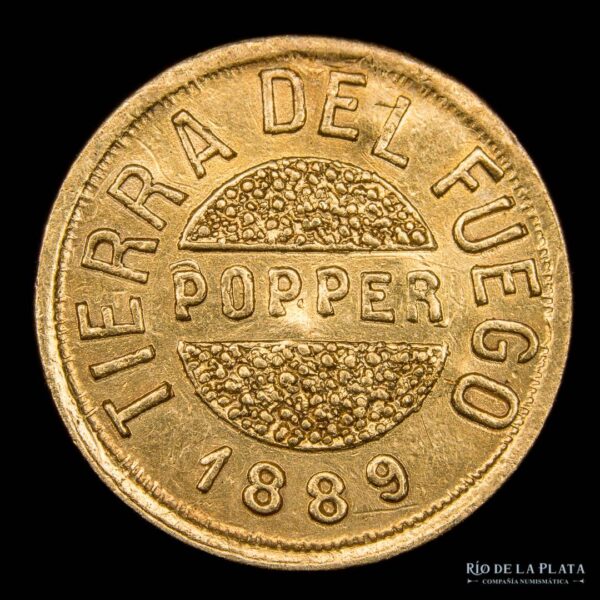
According to some specialists, it is uncertain whether they should technically be considered coins or medals, but this distinction is of little importance, because what is certain is that they circulated as money throughout El Páramo and across Tierra del Fuego. The quantity minted (15,000 grams of gold were used) does not suggest that they were intended merely as souvenirs.
The coins were minted in one-gram and five-gram denominations of pure gold. The five-gram coin featured, on the obverse, two five-pointed stars with the inscription “Tierra del Fuego,” the date “1889,” and the name “Popper.” The reverse bore the inscription “Lavaderos de Oro del Sud” and, in the center, “5 grams.” The edge was ribbed. The one-gram coin bore the inscription “El Páramo.” Both were minted at Popper’s settlement. According to Popper himself, he adapted and improvised machinery, engraved the dies, and through sheer determination minted the first coins made from pure gold extracted at the ends of the world.
Like his machines, these coins can still be seen at the Ushuaia Museum.
The question that remains unanswered is why Popper chose to do this. He cited the lack of regular communications between Tierra del Fuego and the Capital of the Republic, which made it difficult to obtain currency, as well as the inconvenience of conducting transactions with gold dust and nuggets. Surely these were valid reasons. But was this not also a personal satisfaction for Popper? He was an explorer who gave enduring names to rivers and mountains across Tierra del Fuego, a pioneer who founded a settlement, established his own rules, and maintained an almost private army to enforce them. He also had his own currency, bearing his name and seal.
In short, he fulfilled his dream in one of the most remote and unknown corners of the planet, far from his native Romania.
Research and Text: Marita Alasio – Alejandra Torrealba