Traveling in your own car in Patagonia is a challenge many times. Roads and paths are not always well kept or there is no pavement, not to mention the solitude that characterizes the argentine south. Our collaborator Mariano Fernandez Soler reminds us everything we have to have in mind when starting our safe trip.
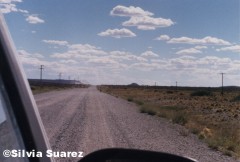 To those who like driving long distances with friends or family and visiting the country by car, Patagonia offers one of the widest and wildest circuit of the country, with many advantages and some of the most beautiful and overwhelming views of the world. When figuring out the budget it is also good to remember that starting at parallel 42, that is, in sierra Grande if driving Route 3 or San martin de Los Andes if driving route 40, petrol costs about half its regular price.
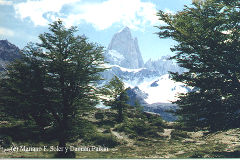 Before hitting the Patagonian road, it’s important to remember that the distances to be driven are very long ones, there are circuits that can go as far as 7,000 kilometers, and also remember to prepare your vehicle in order not to have any inconveniences on the road. I think it’s a myth that, in order to go to Patagonia, you need a 4×4 truck or an indestructible and super car. You just need your will to do it and some precautions. These are some suggestions so that your trip will be a perfect one:
a) Mechanic checkup of your vehicle
Since distances are big and towns are quite separated one from the other in Patagonia, you will often travel (especially on route 3) along a desert; so if your car happened to break down half way between two places (Murphy’s law) you’d find out that the nearest garage or gas station is 100 or 200 km away and help can take more than wanted to arrive. Besides, between places and especially on the routes than join the Andean and the coast regions, cellular telephones will not have service (which will make you want to throw it away through the car window) and help must be asked to passers by who, though few, will stop in the 95% of the cases. This foreword is to pay due attention to the mechanic checkup which will not be the same as for a trip to the near coast.
The principal matters to be technically controlled are:
Adjustment and carburetor: you can take your car to a reliable garage and ask to have everything checked there.
Suspension: since some routes are a little demanding for the car suspension, it’s important for it to be working properly, not only for the comfort of the passengers but also for the long way to travel. It could cause a tire to become useless and also, on rubble roads a good suspension system helps the car go more time on the ground than on the air (really, it’s important).
Brakes: must be working perfectly for obvious reasons.
Electrical System and Lights: it could happen that you have to travel at night and it is necessary to have them working positively, and also it’s no fun to have to push the car up the road if the engine doesn’t start because of insufficiency of battery.
It’s recommended to have the oil changed and align the wheels before departure if the trip is a long one.
b) Tires
It’s a main point for a quiet trip, as well as mechanic checkup. A pair of flat tires, common on rubble roads, can leave you in the middle of nowhere ( as it happened to me in my first trip).
My suggestions are:
All tires must be in a good condition, that is, they must have at least a design of 3 or 4 mm of depth, not be deformed or excessively wasted on the sides (symptom of alignment or suspension problems) and be well balanced.
The minimum number of spare tires for cars is TWO, if you bring only one you will probably remember this website. Logically the spare tires 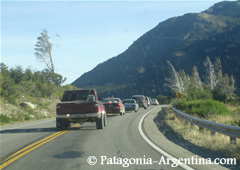 must be in good condition and also be the same type and model of the usual wheels if possible. The reason is not a useless one: if you use two types of tires (radial and conventional), the transmission could be unstable (especially on a wet road); if the designs of the tires are different, the distinct “grip” can cause the action of braking to turn into a loop, especially if the road is wet.
For station-wagons you also need TWO spare tires but, since you have more room for them and if the tires are not new ones, you can carry THREE (in fact, in many places in Patagonia, rural inhabitants, who often have station-wagons, generally carry THREE spare tires).
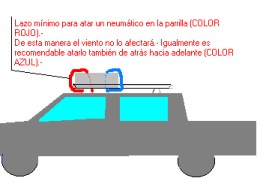
For cars it’s convenient to carry the tires immovably fastened on a roof-rack (bars or grill) for there will be no room for anything else in the trunk if you keep the tires there. Though it’s not a good thing to carry anything on the roof, it’s better to have tires up there and not bags. Tires must be held to the rack in order to avoid their moving back by effect of the wind or air strikes caused by trucks driving in the opposite direction. If the tire is tied up only with the blue rope in the picture, it can move backwards and hit the back window.
The elements to change tires must be in good condition and complete, because if halfway your destination you find that you are missing the tools to pull the security nuts or the handle to make the jack work, you’ll go crazy trying to do magic. Finally, it’s not a bad idea to have a small compressor that works with the car battery; they are not very efficient but they’re better than nothing at all.
c) Tools and spare parts
Though you cannot make a difference between a spark plug and a crank, it’s essential to carry tools and some spare parts in the car. If you cannot repair a deficiency, maybe the person that stops to help could do it and it would be absurd not to be able to fix a minor disadvantage because you don’t have a simple screwdriver or a pair of spark plugs. The most necessary tools are (in my opinion):
* Screwdrivers
* A set of wrench for fixed nuts
* Wrenches
* Pincer for wires
* Hammer
* An iron bar (like the handle of the jack)
* Clamps
* Spark plug remover
* Wire for battery bridge
* WD-40 (useful to dry distributor in case it gets wet)
* A coil of wrapping wire
* Wire of 4 mm and assorted fuses (find out what are the ones for your vehicle and where the fuse compartment is located)
* Flashlight and two spare bulbs for it.
* And obviously, everything you consider might be useful on the road.
Spare parts shall evidently be the right ones for each automobile, but the most common and necessary are:
* Transmission straps
* Spark plug
* Petrol and air filter
* Sealer of petrol tank and oil tank
* Accelerator wire
* Oil of the same brand and type as the one in the oil tank.
* A container with distilled water Again, add whatever you think would be of advantage for your trip.
d) Driving in Patagonia
First of all, think of some very important things before starting your trip:
1) You are on vacations, not in Paris-Dakar Rally.
2) Think that the least thing that an accident will cause will be to spoil your vacations.
3) Your companions depend on you, the driver, so they are in your hands.
4) Don’t try to do in ten days what should take a month: YOU WILL NOT ENJOY IT.
5) Speed limits and traffic rules (especially on rubble roads) are not ornamentation.
6) Get off the city rhythm. There’s a saying that goes “To be in a hurry is only a way to disguise that you have nowhere to go”.
It’s a nice custom, especially in the south of the country, to flash light as a way to say hi to the cars going in the opposite direction. It’s a custom I practice myself, but with an exception: only during daylight because during the night you will blind the other drivers.
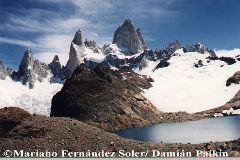 If you ever see a still car on the road, slow down and ask if they need any help, it’s improbable to be robbed, there’s little traffic and the people gentleness in the south is part of the charisma. Besides, if you have a problem you’d love others doing the same for you.
Finally, obey the traffic rules; let’s not keep on increasing the rate of traffic accident fatalities.
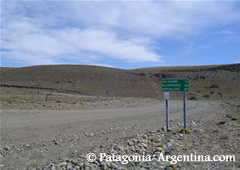 One of the characteristics of the roads in Patagonia is that most of them are of rubble. Rubble is a road improved with a mixture of stone and earth, which is laid down and then smoothed using a machine. Because of the Patagonian roads characteristics, this kind of soil is an cost effective solution for building roads.Rubble is more stable than plain earth since the latter would be blown away by the Patagonian winds, forming dust clouds. Likewise, if roads were made of just sand or light sand (e.g. the entrance to Playa Dorada in Rio Negro), they would be erased by the wind and fords would be formed by the rain.
In Patagonia, only Route #3, some segments of Route 40, Route 22 to Neuquen, the road connecting Esquel with the coast, are paved. The rest of them are of rubble, that’s why when traveling across Patagonia, you have to remember the recommendations about driving on that soil.
There are different types of rubble, which even have different nuances given by the stones in the mixture. An example of this is in the area of Junín de los Andes, entering by Route 40, where you see bluish spots, which soon become reddish ones. The less dangerous stone for tires is the boulder, round stone which is generally taken from edge of the rivers and from certain parts of the beaches while the little stones of granite and limestone of Santa Cruz are more aggressive because they have sharp edges which can cause a flat tire.
The things to have in mind when driving on rubble in Patagonia
1º) Windshield and stones:
When two cars are coming against each other there are two possibilities:
a) the two cars slow down and cross from a distance. Usually, rubble roads are quite wider than paved ones and can have up to 4 lanes (e.g. Route 288 in Santa Cruz).
b) the other car does not slow down (there’s always one of these). In that case you should pass as close to the other as you can so the stones would hit the plate and not the windshield. Generally it is recommended that the person next to the driver pushes the windshield with his/her hand, but I have heard people saying it is not a quite an efficient method for avoiding cracks caused by the stones. I think this only works with laminated glass, keeping them from cracking too much since the other ones burst into “drops” which impede vision.
In case this happens, the most important thing is to keep calm, since you as a driver always have a “memory” of what is about 500 meters ahead, which allows you to brake safely. If you react violently braking to an instant halt, you will probably start to turn over and over across the road.
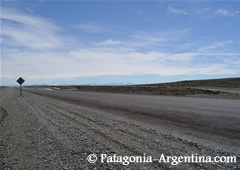 It will happen that you will pass or will be passed by another vehicle. In the first case, announce by means of lights and blinks your intention of surpassing, then move from the other vehicle as far as you can (usually the vehicle to be surpassed will move to the right and it will reduce the march) and return to your rail as far as possible to avoid throwing to it stones and a powder cloud. If you notice you will be passed, let the other know you will let it happen and move to your right, this will avoid (partially, at least) being in the way of the flying stones. Also, reduce your speed and let the other vehicle pass, that will avoid a cloud of blinding dust.
The most advisable thing, although not the most usual, is to put a grill for rubble on the windshield, which will protect it almost in 100% of impacts of dangerous stones. These grills are put in the front part of the car and they leave space for the operation of the windshield wipers. It is also good to make a cross of thick and transparent adhesive tape on the front lights of the automobile to keep them, in the case of a strong stone strike, from breaking completely.
2º) Under the car:
The wheels of the car will lift stones of all sizes, which will hit against the floor. This doesn’t represent any problem for the plate itself, but it can be dangerous for some parts of the vehicle, therefore, you should take into account the following precautions:
– If possible, and if the car doesn’t have it already, a cover-crankcase plate can be placed to avoid fissures. Also, one in the oil tank which are the two critical parts of the car.
– Regarding the protection of the oil tank, there is a foam of expandable plastic that is applied like a dough and when being dried off it expands like a foam that protects in a very efficient way. It is not applicable to the crankcase because it cannot be used in high temperatures, but in the oil tank it is very efficient and also economic. Anyway, as I already said before, it is convenient to have some putty for oil tanks just in case (it costs very little and it saves headaches).
3º) The tires:
The flat tires are more frequent in the rubble roads than in the asphalt, because it can always have stones with sharp borders, but do not be discouraged! This doesn’t mean that you will have flat tires many times, it only implies more precautions than those taken for the conventional roads of asphalt. In the first place, and in the same way that for the paved roads, if you suffer a blowout of the tire don’t stop violently, furthermore, if the circumstances allow it, don’t use the brake to stop the vehicle: do it with the gearbox, reducing the marches until a minimum speed where you can stop the vehicle without any danger.
Also, if a front wheel blows out, the car will stray with certain force toward the side of the blowout (due to the difference of inclination and grab of the vehicle), so it is very important to drive with the two hands in the steering wheel, in a comfortable and correct position “the position ten to two according to the experts”, which allows, in the case of an accident, to maneuver correctly without getting your hands entangled.
In case a back tire is deflated, if the brake is applied the car will tail and maybe end up spinning. For that reason, the car will be braked with the gearbox. And, no matter how obvious it is, if a tire blows out in the rubble, although you are in the desert, move to the side of the road: although it seems that nobody will appear, some vehicle could come and an avoidable accident can take place.
4º) The driving:
To drive on the rubble is not the same as to drive on the asphalt: the wheels go bouncing and they have a time on the air and another on the floor. Remember that you are on vacations and not in a rally, so keep a constant speed but never one over 70-80 km/h. If going any faster, any event will send you directly to the field. Remember that the problem is not the vehicle, but the floor: the vehicle goes part of the time on the air, for that reason: don’t RUN, it doesn’t make sense.
In some routes, there are abrupt variations in the quality of the road that can change a rubble that seems a billiards cloth to one that seems a bombarded field: if you enter in a road full of holes at great speed, the most probable thing is that you will end up calling the crane. All the above-mentioned doesn’t mean that you have to travel the rubble roads at 10 km/h and with fear of suffering an accident or to break the car down, it means that it should be driven with CAUTION, without trying to make any tests of speed.
Finally, some recommendations for the mountain roads: in places of blind curve, that is to say, where you don’t see if somebody is coming, before arriving to the curve, use the horn if it is in the day or lights if it is at night; drive with some low window to listen to other vehicles; pay attention: if you see dust cloud near it is a car coming. And always keep your right.
5º) The myths:
I have always listened different voices regarding 3 topics: The pressure of air of the tires to drive in the rubble, the way to drive in the places where there are ” pianos ” and how to cross “guardaganados”.
a) regarding the pressure of the tires, some have recommended me to inflate the tires to a higher pressure than the normal one, so that the tire is harder and, others said that it is necessary to lower the pressure of the tires a little, so that the tire is softer. However, a garage man of the area told me: either leave the pressure normal or a little low, because if you harden the tires the car will travel bouncing, it will make the suspension work bad and the tires are not harder than the stones, so sooner or later a sharp stone can blow it out “, and I found this the most reasonable thing of all. Also, I believe that if the tires are a little softer than the normal thing, they can take the form of the stone without too much resistance, avoiding a blowout maybe.
b) The pianos are irregularities of the road that are formed by the wind after they passed the motor-leveler, or when this changes the speed while the shovel is in contact with the floor. They can also be formed in the curves and slopes by the traction of the tires of the cars. Basically they are transversal waves of the road that make the vehicle jump. Many times they have recommended me to pass them very quick so you don’t notice them”, but once I spoke with my mechanic and he told me: If you drive fast over a piano you will go literally in the air, if you need to maneuver in that moment, the most probable thing is that you lose the control of the car.
Pass it slowly, it will feel a little more the nuisance of the wave but the suspension will work less and you will be able to maneuver if you need it.” All this is personal and it also depends on the experience of each one, but they are suggestions that can be good in order not to have problems in a trip which should be unforgettable because of the beauty of the landscapes and not because you had problems with the car.
c) Finally, if you see a “guardaganado”, pass it SLOWLY. Frequently the wind sweeps some of the earth that is in the borders, leaving uncovered a step of concrete of about 10 or 15 centimeters. If you pass it at high speed, the suspension will suffer a big impact and probably break.
I hope sincerely these suggestions will be useful so that you travel happily across the roads of Patagonia, without any type of problems, enjoying the landscapes, the people and the places that it offers.
Mariano Fernandez Soler
- Trains in Patagonia: the facts
- The First 100 Years of the Cape of the Virgins Lighthouse
- When Brazil tried to invade Argentina
- A 5000 kilometers long Tourist Corridor
- The Conditions of the Road and Recommendations
- Route 40: From Bariloche to El Bolsón
- Route 40: From El Bolsón to Esquel
- Route 40: From Esquel to Gobernador Costa
- Route 40: From Gobernador Costa to Alto Río Senguer
- Route 40: From Alto Río Senguer to Río Mayo
- Route 40: From Río Mayo to Perito Moreno
- Route 40: From Perito Moreno to Gobernador Gregores
- Route 40: To Cañadón del Río Pinturas and Cueva de las Manos
- Route 40: To Los Antiguos and Lago Buenos Aires
- Route 40: From Gobernadores Gregores to El Calafate
- Patagonia’s Lighthouses
- San José Fort – Bird Island