Different indigenous races inhabited Patagonia thousands of years before the arrival of the Spaniards.
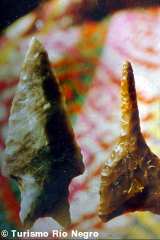
 Their culture was not advanced and this is the reason why we find only a few traces of these peoples (funeral deposits, caves, cave paintings, stone or shell work areas). The best reference of these inhabitants have been obtained in the archeological sites of El Juncal, near the city of Viedma, in the east of the Province of Río Negro. The “Black Skulls” were found there, so called because of the salt impregnation during their long burial.
Before the Desert Conquest, the area was one of transition between two completely different indigenous races. One came from the pampas and the other one from the Pacific Andes: the argentine Tehuelches and Chilean Mapuches.
The Tehuelches inhabited from the Colorado River to the Magellanic channels. They were nomads, spoke the Ken group language and were hunters of guanacos and ostriches. Their physical appearance was stout, their average height was 6 ft. 10 in., with a thin and elongated head. They were called Patagones because of their appearance. Antonio Pigafetta, a member of Magellan’s expedition, described his encounter with a Tehuelche indian:
 “One day, a gigantic man appeared before us. He was so big that our head would barely reach his waist. His face was wide and painted in red. His robe was made of skins , of a local animal, and well sawn. This animal has the head and ears of a mule, body of a camel, deer legs and the tail of a horse…He was wearing some sort of shoes made with the same skin.”
Their life was conditioned by a very hostile environment: terrible winds, extremely cold winters and lack of water, which prevented them from farming.
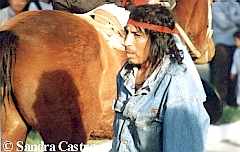
By contrast, the mapuches were short and robust, with a wide and round head, with a superior cultural level due to their sedentary customs. They were farmers and hunters, with a knowledge of weaving and pottery. The mapuches (name meaning people from the land) originally inhabited Chilean territory.
In the 18th. Century, driven by the Spanish invasion, they learned to ride horses and moved to other lands. The entered the argentine Patagonia, which marked the beginning of the agony of the Tehuelche population.
They occupied northern Patagonia and the south of the pampa plains, and given their more evolved culture and bellicosity, they imposed their customs and language, and finally overpowered the them. This, added to the Spanish extermination and the incorporation of white cultural features, determined the end of the Tehuelches.
Some of the present groups are descendants of the original tribes, with leaders and chiefs, others were built based on dispersed families and ethnic mixtures. The present areas occupied by aborigines correspond in its majority to arid lands, with low precipitation, scarce and hard grass. They are poor in organic matter, where there is no meaningful water resources, neither superficial nor underground.
The climate is cold and harsh, with extreme temperatures most of the year, seven months of drought and dry and intense winds. These special geographical and climatic conditions prevented the development of suitable vegetable species for feeding cattle and population.
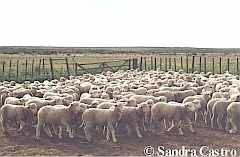
The only possibility is sheep and goat breeding. Such characteristics induced the white man to postpone the occupation of those territories, and limiting to the possession of these lands for the extensive exploitation of the sheep herds. This facilitated the permanence, until today of those aborigines, which constitute the most important indigenous groups in the country.
The mapuche population in the region is today estimated at 40,000, although the young emigrate to the cities in search of economic welfare.