Hikes near Mt. Fitz Roy: a cheat sheet with trails according to time available and the different levels of difficulty
For one day or less
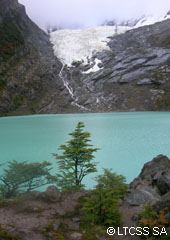
 Fitz Roy Lookout Point (Mirador del Cerro Fitz Roy): 1:30 one way, with a climb of 350 meters and low difficulty.
- Lake Capri (Laguna Capri): 1:45 one way, a climb of 350 meters and low difficulty, although there is a straight climb in the beginning.
- Lookout Point Cerro Torre (Mirador del Cerro Torre): 1:30 one way, with a climb of 250 meters and low difficulty, and a straight climb.
- Chorrillo del Salto: 1 hour one way, without a climb, and not difficult. Ideal for days with bad weather. You can also get there by vehicle, and later do a very short walk.
- Piedra del Fraile: 1:45 one way, without a climb, the path begins crossing the bridge above the Eléctrico River, and it goes along private property, bordering the river.
- Estancia Madsen: 45’ one way, without a climb, little effort needed, you must cross a footbridge.
- Lago Viedma: arrive by car. You can also sail.
- Lago del Desierto: arrive by car. It is only 40km from El Chaltén, but because it is a mountain road the trip could take two hours or more.
For a bigger challenge, lasting between two and four hours, one way
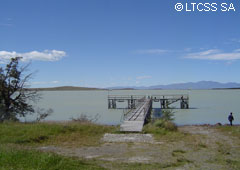
 Poincenot: 2:45 one way, with a climb of 350 meters, it has the last view of the mountain until Laguna de los Tres.
- Río Blanco: 3 hours one way, with a climb of 350 meters, there is no view of the mountain, ideal for days with bad weather.
- Laguna de los Tres: 4 hours one way, with an ascent of 750 meters, the view of Fitz Roy is excellent, the climb is very vertical.
- Piedras Blancas: 4 hours one way, 450 meter ascent, it is a good alternative if you can’t see the mountain that day.
- De Agostini: 2:45 one way, with an ascent of 250 meters, there is a campground on the shores of the lake of the Fitz Roy river.
- Laguna Torre: 3 hours one way, 250 meter ascent, it has a excellent view of the top of the mountain.
- Maestri Lookout Point (Mirador Maestri): 4 hours one way, 300 meter ascent, it has a good view of the Big Glacier (Glaciar Grande).
- Loma del Pliegue Tumbado: 4 hours, 1000 meter ascent, it is a mountain with an excellent view.
- Bahía Túnel: 2:30 one way, with an ascent of 100 meters, including time in a boat.
NOTE: Almost all of these hikes can also be done on horseback.
For advanced climbers, only with a guide
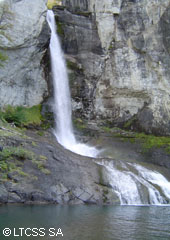 Climbing the Glacier: 8 hours in total, 5 on ice, with ice climbing equipment needed.
- Laguna Toro: 7 hours one way, 500 meters of ascent, only for experienced climbers.
- Continental Ice (Hielo Continental): options for three and ten days, camping above ice, depending on the weather conditions.
Advice for everyone
- Use comfortable well-worn shoes or boots (not brand new ones), to prevent blisters.
- Keep in mind that the entire path has to be hiked back to return to the base.
- If you are going to camp, bring an extra pair of comfortable shoes to use.
- You should bring extra socks.
- Bring a water bottle. In many cases you can refill them in streams or rivers.
- Even though some of the hikes are short, you should always bring some food. The best are lightweight foods that have a lot of energy, such as chocolate, dried fruit, raisins, etc.
- If you are going to camp don’t forget a food cooker and a garbage bag. You should also bring a container to wash utensils with biodegradable soap, far away from water sources.
- Remember that everything you bring with you needs to leave with you. Nothing should be left behind in the campgrounds or in the trails. You will find garbage cans at the beginning of each trail.
- Don’t forget sunglasses and a flashlight, even if you won’t be hiking at night, just in case.
- Dress in layers that are easy to remove and put back on, and always bring rain gear.
- Sunscreen and insect repellent are good things to have.
- To prevent getting lost, look at the path, and if there are two, chose the one that is better marked. Don’t get separated from your hiking companions. And always ask at what time the sun sets.
- To reach many of the places that are on the maps you have to cross private property. Always ask the permission of the owner.
- PREVENT FOREST FIRES. Remember that it is not permitted to make fires with logs in any part of the park. Stub out cigarettes well and keep the stub in your bag until you find a trash can. Remember that the smallest spark can start a forest fire.
- If you are going to camp, don’t make trenches around the tent, they aren’t necessary. Use the latrines or make your necessities at least 100 steps away from any water source and bury it with the paper you use.
- Remember the slogan: LEAVE NO PROOF BEHIND THAT YOU WERE THERE. Every person has the right to feel that they were the first person to see that place. And as someone using the national park, it is your responsibility to protect it.